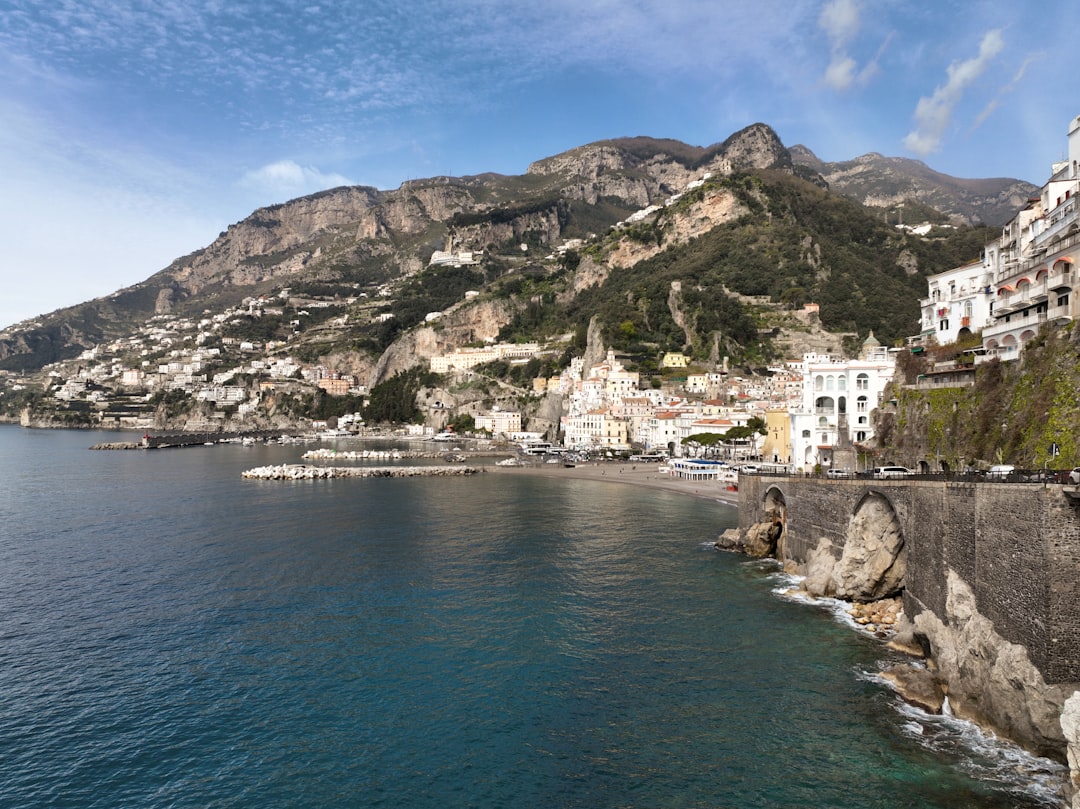
A well-composed amalfi coast itinerary does not move you from town to town every night. It plants you in one place — a villa with a long table and a terrace facing the sea — and lets the coast come to you: by ferry, by trail, by slow morning light. Seven days is the right amount of time. One base is the right structure. What follows is the version most groups never find.
Quick Pick: Amalfi Coast in 7 Days
- Group wanting a real home base → Praiano villa; fewer tourists, west-facing sunsets, central location
- First-timers who want the iconic scene → 2 nights in Positano first, then settle into Praiano
- Group with cultural priorities → anchor a full day in Ravello; Villa Cimbrone, the cliff gardens, a long lunch
- Boat day timing → schedule mid-week; May and September charters book earliest
- What to skip → July and August; hotel-hopping between every town; 9am port tours that return you at 1pm
- Best months → May, early June, September, October
| Town | Best for | Crowd level | Skip if | Drive from Praiano |
|---|---|---|---|---|
| Praiano | Groups wanting a private villa home base | Low | You need constant restaurant options steps away | Base |
| Positano | First-time visitors; groups who want the scene | High | Staying more than 2 nights; it's difficult to settle in | 15 min |
| Ravello | Cultural depth, elevated views, garden quiet | Low–medium | You want beach access without a long drive | 35 min |
| Amalfi Town | Historical draw, market energy, logistics hub | Medium–high | You want quiet mornings; the piazza is busy by 9am | 20 min |
What Does a 7-Day Amalfi Coast Itinerary Actually Cover?
A strong 7-day Amalfi Coast itinerary covers five distinct experiences: a full day in Positano, a boat day on the water, the Path of the Gods hike, an afternoon in Ravello, and a morning in Amalfi town — all anchored from one villa base you return to each evening. Days one and seven are arrival and departure. The remaining five are the ones that stay with you.
The most common mistake is building the itinerary around the coast road. Moving from Positano to Amalfi to Sorrento and back, by day five you have photographed every staircase but nothing has settled. The coast rewards a different structure: one home, a few intentional days out, and enough empty mornings to let the place register.
A private villa in Praiano, or anywhere between Positano and Amalfi town, gives you that structure. You return to the same table each evening. The light through the kitchen window at 7am is the same every day. The group finds its rhythm without being managed through one. That is the itinerary.
Where to Base Your Group
Praiano is the most practical answer for a group of 8 to 12. It sits roughly halfway between Positano and Amalfi town, faces west for the late afternoon light, and has almost none of the tourist congestion that makes Positano harder to sink into. Private villas here tend to be spacious and priced better than their Positano equivalents, with terraces wide enough to hold a full group at once.
Positano works well if your group has never been and wants to feel the energy of the place on arrival. The town is vertical and photogenic and correctly famous. It does not lend itself to slow mornings if you are near the beach strip. Two nights here, then a move to Praiano for the rest of the week, is a reasonable structure for first visits.
Ravello is for the group that wants elevation and quiet. Recognized as part of the UNESCO Amalfi Coast World Heritage Site, Ravello sits 350 meters above the sea on a ridge with views the coast road never offers. It is more convincing as a full-day destination than a base, but a villa there gives you the coast without the coast's noise. Better for groups of four to six who want near-total privacy.
Amalfi town serves best as a day trip, not a base. The cathedral and the old paper mill justify a full morning. The piazza is lively in a way that rewards visiting, not living in for a week.
Your 7-Day Plan
This plan is built around a Praiano villa. Shift the boat day and the hike based on the week's weather forecast. Those two days need clear skies.
Day 1: Arrive and find the rhythm. Your job on day one is to learn the house. Where the coffee is. What the terrace looks like at different hours. A short walk to the sea before dinner. Eat at home or at the trattoria two streets below. Nothing else.
Day 2: Positano. Take the ferry, not a car. You spend less time parking and more time in the town. Positano is worth a full day: the upper village streets in the morning before the tour groups arrive, the beach by noon, a long lunch somewhere with a view, and the ferry back in the late afternoon. John Steinbeck wrote about Positano in Harper's Bazaar in 1953 and it has not stopped being worth a full day since.
Day 3: The hike. The Path of the Gods, the Sentiero degli Dei, runs 8 to 10 kilometers from Bomerano near Agerola down to Nocelle above Positano. The trail is marked with red-and-white blazes and is free to walk year-round, taking 4 to 6 hours at a relaxed pace. Start by 8am. The path moves through terraced vineyards and Mediterranean scrub with long views of Capri and the Li Galli islets below. The final stretch descends 600 meters into Nocelle. It is not a casual walk. It is the most honest way to understand the landscape you have been looking at from the terrace all week.
Day 4: Boat day. A private charter from Praiano or Positano runs 6 to 8 hours. The route typically covers the sea caves near Conca dei Marini, a swim stop near the Capri Faraglioni, and lunch at anchor somewhere between. This is a different experience from a tour boat. The water, from out there, is different. The coast, seen from the sea, finally looks the way the photographs suggest it does.
Day 5: Ravello. Drive up before 10am. Walk to Villa Cimbrone and stand on the Terrace of Infinity, a cliff-edge garden balcony with a 180-degree panorama of the coast below. The gardens are open to visitors who are not hotel guests. Villa Rufolo, a 13th-century complex at the center of town, is where Wagner composed part of Parsifal; the terraced gardens now host the annual Ravello Festival. Lunch in town. Return to the villa by late afternoon.
Day 6: Amalfi town. The 9th-century Cathedral of Sant'Andrea anchors the main piazza. The Museo della Carta, a working paper museum inside a medieval mill, takes 45 minutes and earns them. The town has good ceramics and limoncello and the kind of market energy that Positano, for all its beauty, lacks. Take the ferry back in the afternoon.
Day 7: The slow morning. One last coffee on the terrace. A final swim if timing allows. Then the drive to Naples or the ferry to Sorrento for the train north.
What Most Groups Get Wrong on Day Three
The hike is the first thing cut when a group itinerary gets loose. It requires an early start, coordination for the bus back from Nocelle, and a few hours of walking that some group members may find harder than expected.
Most groups replace it with a second boat day. That is not a bad choice, but it is a different experience. The boat gives you the landscape as spectacle. The hike gives you the landscape from inside it. Both are worth doing if you have seven days. The hike belongs earlier in the week, before legs tire and the rhythm of afternoon naps sets in.
The trail runs from April through October without restriction. May and September offer the best conditions: temperatures in the low 20s Celsius, low humidity, and the vineyards either in early green or beginning to turn.
When Is the Best Time to Visit the Amalfi Coast?
May, early June, and September are the best months for a group trip on the Amalfi Coast. The water is warm enough to swim, the trails are clear, and the towns are busy but not at capacity. Late July and August are Ferragosto season, when Italian vacationers join international tourists and every stretch of coast reaches its limit. Water temperatures peak in late August and September, making September the best month for a group that prioritizes swimming over hiking.
October is quieter than September and cooler for swimming, but strong for the cultural elements: Ravello's gardens, the cathedral, the paper museum, the hillside villages without the heat. November through March, most private rental villas close for the season and ferry schedules shrink. The coast becomes introspective and nearly empty, which suits certain groups very well, but requires different planning.
If the group has flexibility, May is the answer.
Amalfi Coast vs Cinque Terre vs Sicily: Which Is Right for Your Group?
These three destinations appear together in almost every "Italy group trip" conversation. They are not interchangeable, and choosing between them shapes the entire character of the week.
Amalfi Coast vs Cinque Terre: Cinque Terre is five pastel villages connected by trail and rail in Liguria, more intimate and more hiking-focused than the Amalfi Coast, with a smaller private villa market and less accommodation infrastructure for larger groups. For a group of 8 to 12 wanting a genuine home base with space, the Amalfi Coast offers considerably more. Cinque Terre rewards a shorter stay, two to three days. The Amalfi Coast needs a week to settle into. If the group has done one, the other is worth it next.
Amalfi Coast vs Sicily: Sicily is a different tempo entirely. Two weeks is the minimum to move through even part of the island with intention. For a group with seven to ten days, Sicily is too much to hold. For a group with ten to fourteen, Sicily's villa infrastructure, particularly around Noto and Taormina, rivals the Amalfi Coast's at a better price point and with more culinary depth. The Amalfi Coast is the better seven-day trip. Sicily is the better two-week voyage.
For more on how the choice of Italian region changes the character of a group trip, read through the girls trip destinations guide and the Tuscany where-to-stay guide for a useful comparison.
How to Plan the Amalfi Coast Without Doing It All Yourself
Most groups who struggle with an Amalfi Coast trip struggle with the same things: the villa shortlist that becomes a spreadsheet, the boat booking that requires a phone call in Italian, the group chat that generates seventeen restaurant options and no decision, the reservation that falls apart when one person's ferry is late.
The logistics are not complicated in isolation. They compound. Someone needs to track the ferry schedule on the day the weather shifts. Someone needs to know which table at dinner requires a call, not a reservation app. Someone needs the number for a driver in Praiano who works on an hour's notice.
When those details are held by someone else, the week feels different. The morning is longer. You are not managing the trip. You are in it.
Wndrlust designs villa-based voyages for groups of 8 to 12 women who want that version of the coast. The itinerary, the villa, the chef, the curated experiences — composed rather than assembled. If this is the week you are looking for, explore current voyages to see what is open.
The Week That Stays
Seven days on the Amalfi Coast does not resolve into a list of things seen. It resolves into the particular light on the water on day three, and the sound of the group still at the table well past midnight, and the way Ravello felt smaller than expected and somehow larger at the same time.
The coast does not give you more if you move faster through it. The groups who remember it most clearly are the ones who committed to one place and let the week become something other than a trip. That version of the itinerary is available. It takes a certain kind of planning to get there, or the right people holding the planning so you do not have to.