TL;DR
The Amalfi Coast has five meaningful bases: Positano for iconic views and high energy, Ravello for elevated calm, Praiano for quiet evenings and good light, Amalfi Town for transport access, and Atrani for something almost no one else chooses. Where you stay on the Amalfi Coast shapes everything, from how you move to how the evenings feel. The right answer depends less on the coast and more on what kind of trip you are building.
Quick Pick
- First-time visitor, wants the iconic view — Positano. Steep, expensive, worth it once.
- Groups prioritizing calm and connection — Praiano. Quieter, more private, the coast's finest sunset position.
- Views without beach crowds — Ravello. High on the cliffs, unhurried, away from everything.
- Easy movement and cultural depth — Amalfi Town. The transport hub, with real local life still intact.
- Something almost no one stays in — Atrani. Five minutes from Amalfi Town, half the price, barely a tourist in sight.
- Optimal travel window — May, September, early October.
Comparison: Amalfi Coast Bases at a Glance
| Town | Best for | Drive to Amalfi Town | Tourism level | Price range | Beach access |
|---|---|---|---|---|---|
| Positano | Iconic views, visual impact | 30 min | Very high | €€€€ | Yes (steep descent) |
| Ravello | Calm, elevated views, groups | 20 min | Moderate | €€€ | No (bus or taxi down) |
| Praiano | Quiet stays, groups, sunsets | 15 min | Low to moderate | €€–€€€ | Yes (cove) |
| Amalfi Town | Transport, culture, history | Center | High (midday) | €€–€€€ | Yes |
| Atrani | Solitude, local life, value | 5 min walk | Very low | €–€€ | Yes |
What Is the Difference Between Staying in Positano Versus the Other Towns?
The Amalfi Coast's towns divide into two broad categories: the ones you have already seen on a mood board and the ones that reward a longer stay. Positano is iconic and high-traffic. Ravello is elevated and tranquil. Praiano is the quiet interval between them. Amalfi Town is the coast's practical center. Atrani is the town even frequent visitors miss. The right choice depends on what the trip is actually for, and how much of it you want to spend managing logistics versus living inside the place.
The entire coast sits within a UNESCO World Heritage Cultural Landscape, inscribed in 1997 for its blend of natural geography and centuries of terraced agriculture, maritime history, and accumulated architecture across fifteen communes. UNESCO designation means different things in different towns, though. In Positano it manifests as a thousand visitors by 10am. In Atrani it means a handful of regulars at a piazza café that has not changed its prices since the previous decade.
The most useful framing for a group planning this trip: choose the town where your evenings make sense. A communal dinner at a Ravello villa with the lights of the coast far below. A Praiano terrace as the whole western sky goes orange. The decision is atmospheric, not logistical, and it shapes the trip more than any single restaurant or activity will.
Positano: The View That Costs You
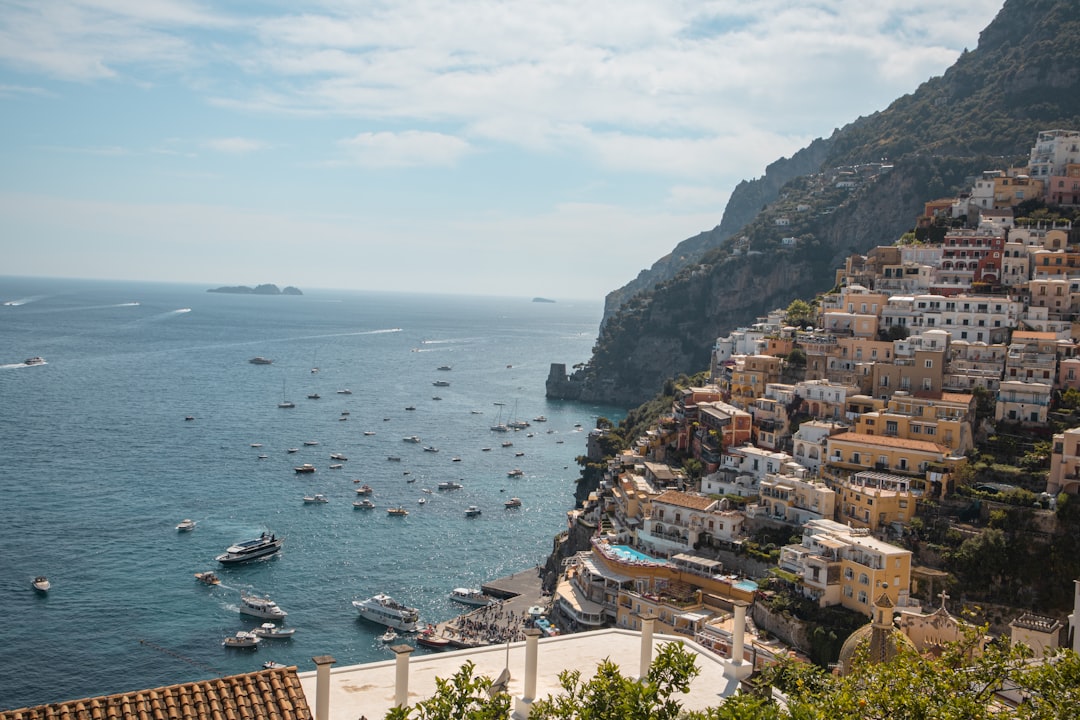
Positano is the Amalfi Coast at full volume. The houses are real, the light is real, the steps are real. There are roughly 4,000 residents and, in August, something closer to that number arriving by boat each hour.
The aesthetic density is unmatched on the coast. You step off a ferry or bus into a town built at a vertical angle, with ceramic-fronted shops and bougainvillea and a harbor that genuinely looks like the photograph. For a first visit, that arrival experience has value that is difficult to overstate.
Best for: First-time visitors who want the full visual impact; couples willing to trade logistics for atmosphere.
Why it works: Positano has two beaches, good boat connections to the rest of the coast, a genuine density of restaurants and shops, and a light in the late afternoon that explains why this particular town has been painted and photographed for a century. It earns its reputation.
Skip / Avoid: July and August entirely, and July evenings with equal urgency. Overtourism on the Amalfi Coast has increased by roughly 9% since 2019, and Positano absorbs the largest share. The stairways become impassable midday, the restaurants price for captive foot traffic, and the view from any window includes several dozen other visitors at any given moment. For groups staying five or more days, the novelty settles into something more like a managed experience than a lived one.
One night in Positano, arriving by boat, departing the next morning before the first cruise ships dock: this is how experienced visitors now approach it.
Ravello: Elevated, Composed, Away from Everything
Ravello does not have a beach. It does not have a ferry terminal. It sits 365 meters above the sea on a ridge accessed by a road that switchbacks up from Amalfi Town in about twenty minutes. What it has instead is a composure that the coastal towns largely lack and that a certain kind of traveler will recognize immediately.
The day-trippers arrive in the morning and leave by 5pm. After that, Ravello becomes a different place entirely: the piazza empties, the restaurants fill with people who are staying rather than passing through, and the views across the Tyrrhenian in the evening light carry a quality that is difficult to describe without sounding hyperbolic.
Best for: Groups that want the Amalfi Coast as a contemplative experience; villa rentals where the property itself is the destination.
Why it works: Ravello has some of the most compelling views on the Italian coastline, two historic gardens (Villa Cimbrone and Villa Rufolo), and the Ravello Festival, a classical music program that has drawn serious audiences since 1953. Restaurants here price for guests who are staying, not visitors who have ninety minutes before their ferry. The scale of the town rewards the kind of slow, repeated walking that turns a place from backdrop to home.
Skip / Avoid: Anyone whose trip is organized around beach time. Getting to the water requires a bus down to Atrani or Amalfi Town and back, which works well as a morning excursion but adds friction if repeated daily. Groups who want to wake up and walk to the sea in ten minutes will find Ravello a beautiful inconvenience.
For groups arriving on a villa trip where the property is the base and the coast something you visit rather than inhabit, Ravello consistently produces the trips people carry for years.
Praiano: The Town That Gets the Better Light
Between Positano and Amalfi Town, facing southwest along a hillside that catches the full western exposure, Praiano is the answer to a question most visitors never think to ask. Small, quiet, and positioned for the kind of sunset that Positano, facing more directly south, does not see in the same way.
Praiano has a fraction of Positano's visitor count, its own small coves (Marina di Praia is a ten-minute walk), and a set of restaurants that have been feeding locals for decades rather than tourists for seasons. It also has more accessible parking than anywhere else on the coast, which matters for a group renting a hillside villa and driving down to the sea.
Best for: Groups who want quiet evenings, a less managed experience, and villa-level privacy without villa-level isolation from the rest of the coast.
Why it works: The atmosphere. Praiano has a slower pace than its neighbors that is not the result of having nothing to offer but of simply not having curated itself for volume tourism. The town faces the light well, the coves are swimmable without a crowd, and the coastal road connects easily to both Positano (twenty minutes west) and Amalfi Town (fifteen minutes east).
Skip / Avoid: Anyone expecting nightlife or the full hotel-amenities infrastructure of a larger town. Praiano is genuinely small. What it offers is presence and space, not scale.
When Is the Right Time to Stay on the Amalfi Coast?
May, September, and early October represent the right window for a group trip to the Amalfi Coast. Weather holds across all three months, ferry and restaurant schedules run at full summer capacity, crowds are either not yet present or have pulled back as European school terms begin, and the coastal light carries a quality that mid-summer's white sky and heat haze does not.
July and August are a different coast. Overtourism has transformed peak-season conditions on the road that connects every town, with three-hour delays common on distances that take thirty minutes in any other month. Ferragosto, August 15, marks the height of Italian domestic tourism layered over international visitor volume, and the experience in most towns shifts from atmospheric to managed. May flights and September villa rentals typically cost 30 to 40 percent less than equivalent July dates, for meaningfully better conditions.
For groups, timing also affects availability of the private villas that make the coast work as a long stay. May and September open up properties that are locked into short-term weekend pricing in July, and the longer booking windows allow for the kind of curated experience planning that a three-night summer rental does not.
Amalfi Town, and the Alternatives Worth Knowing
Amalfi Town is not the most visual base on the coast, but it is the most practical. The two main SITA bus lines intersect here. The ferry terminal provides direct access to Positano, Salerno, and Capri. The Cathedral of Sant'Andrea, dating to the 9th century, sits in a piazza that, outside of the midday cruise-ship window, is one of the more genuinely local settings on the coast.
Best for: Groups who want to move around the coast freely without committing to a car or managing ferry schedules from more remote towns.
Why it works: Access, in both the physical and logistical sense. You can leave Amalfi by 9am and be in Ravello for lunch, back on a boat to Positano by mid-afternoon, and home for dinner without a taxi or a traffic delay. For groups combining the coast with day excursions to Pompeii, Naples, or Capri, the connections from Amalfi Town simplify the planning considerably.
Skip / Avoid: The main piazza between roughly 11am and 3pm, when cruise passengers arrive in volume. Amalfi Town rewards early mornings and late evenings. Midday belongs to someone else.
Atrani deserves a specific mention here. Five minutes on foot east of Amalfi Town, it is one of the smallest municipalities in Italy and rarely appears on itineraries. It has a black-sand beach, a small fishing harbor, the Chiesa di Santa Maria Maddalena, and a handful of restaurants that remain as close to genuinely local as the coast offers. Groups who discover it on a first trip tend to base themselves there on a second.
Amalfi Coast vs. Tuscany vs. the Côte d'Azur
The Amalfi Coast competes for attention with a short list of European alternatives, and the comparison is worth making honestly.
Vs. Tuscany: Tuscany offers more physical space, gentler logistics, and a villa culture oriented around staying in one place while the landscape comes to you. The Amalfi Coast is more compressed and more visually intense. For groups that want to move, be on the water, and feel the specific energy of a coast that has been photographed and painted for a century, the Amalfi Coast is the right choice. For groups that want a private pool above vineyards and a week that unfolds without a car journey, the Tuscany group travel guide is the better reference.
Vs. the Côte d'Azur: Both offer luxury coastal infrastructure, but the Côte d'Azur has significantly better road access and a wider range of villa options. The Amalfi Coast has an atmosphere the Côte cannot replicate. First visits to the Mediterranean almost always reach for the Amalfi Coast. Return visits often choose the Côte for its ease.
Vs. Cinque Terre: Cinque Terre shares the vertical coastal aesthetic but lacks the Amalfi Coast's villa stock, culinary depth, and coastal range. Better suited to a two-day walk than a five-day stay.
How to Stay on the Amalfi Coast Without Managing It Yourself
Most group trips to the Amalfi Coast begin as a shared document. Someone takes the ferry times, someone handles the restaurant reservations, someone books the villa and spends three weeks in a message thread clarifying what "sea view" actually means in a listing photograph.
The coast rewards the kind of travel where those logistics have been resolved before arrival. Where the driver is already there, the villa is already stocked, and the evening table has already been reserved. Not because that is easier, though it is, but because the Amalfi Coast has a pace and an atmosphere that disappears the moment the trip becomes an operational task.
The Wndrlust approach for this coast is villa-based and intentional: one private property as the home, a chef who knows the local markets and the rhythms of a group, and a curated set of days that move at the pace of the people rather than a ferry timetable. See how that comes together on the current voyages page.
Conclusion
The Amalfi Coast justifies its reputation in a way that is rare for a place this famous. It really does look like that. The light really does do that thing in the late afternoon.
But the experience of staying here varies considerably depending on which door you walk through each morning, and for groups, that variation is amplified. A hotel room in Positano in August and a private villa in Praiano in September are not the same coast.
Choose Positano for one extraordinary arrival. Choose Ravello if the trip is about composure, long views, and evenings that feel earned. Choose Praiano if you want something that feels like yours rather than shared. Choose Amalfi Town for freedom of movement.
And once you have chosen the town, build the stay around a private villa. On this coast, the private terrace at dusk, with no one else's timeline but your own and the whole Tyrrhenian going dark below you, is where the Amalfi Coast actually becomes itself.
For how to structure your days once you've chosen a base, the Amalfi Coast itinerary guide covers the full week.